Most communication training is a lecture, not practice. Someone stands up front with a slide about “active listening,” everyone nods, and by Thursday nothing’s actually changed.
Here’s the part that makes it worse: most people think they communicate just fine. So when something does break, a missed handoff, a meeting where three people walk away with three different understandings of what was decided, the instinct isn’t to look at how the conversation actually went. It’s to assume it was someone else’s fault.
The problem isn’t that people don’t know communication matters. It’s that “communication skills” almost never get practiced, they get talked about, and blamed about after the fact. Improv flips that. Every exercise below puts people in the actual position of listening, clarifying, and building on someone else in real time, not reading about how they should.
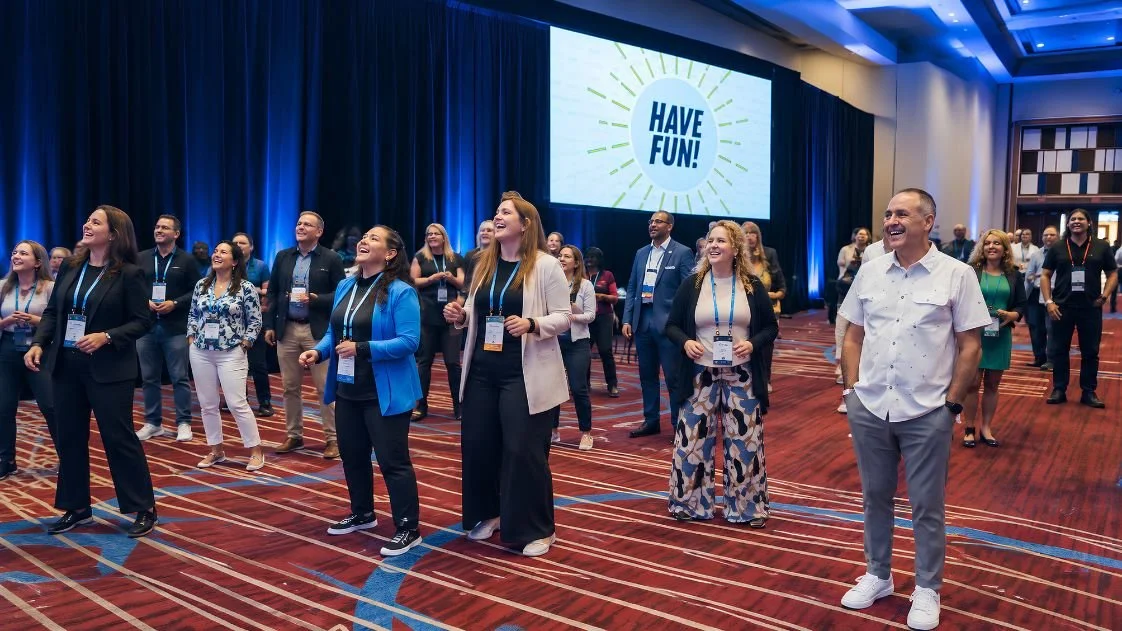
Why Improv Works Where Lectures Don’t
Improv only works when two people are actually listening to each other. There’s no script to fall back on. If you’re planning your next line instead of hearing what your scene partner just said, the scene falls apart immediately, everyone in the room can tell.
That’s the whole appeal for teams: these games make bad listening visible in about thirty seconds, in a low-stakes way, instead of showing up three weeks later as a missed deadline. According to a survey by Fierce, Inc. of more than 1,400 employees, executives, and educators, 86% cite poor communication or a lack of collaboration as the primary cause of workplace failures. I’ve seen that same pattern firsthand across wildly different industries. I’ve worked with doctors, software engineers, financial planners, and electricians, and no matter how different the actual work is, communication is almost always the first thing they name as a challenge.
1. Back-to-Back Description
What it builds: specificity, checking for understanding
How to run it: Pair people up, sitting back to back so they can’t see each other. Give one person a simple image (a shape, a basic diagram). They describe it out loud while their partner tries to draw it, without looking, and without the describer seeing the drawing until it’s done.
The gap between the two drawings is the whole lesson. It’s rarely because someone described badly, it’s because nobody asked a clarifying question along the way.
2. Gibberish Translator
What it builds: reading tone and nonverbal cues
How to run it: One person speaks in complete gibberish, no real words, but with real emotion and intent behind it. A “translator” standing next to them interprets what they’re “saying” for the group, based purely on tone, pacing, and body language.
This one makes people realize how much of communication isn’t the words at all. Teams that do this together get noticeably better at reading tone in real meetings afterward.
3. Yes, And, No, Or Circle
What it builds: honest responses, not just polite agreement
How to run it: In a circle, one person offers a simple statement (“We should redesign the break room”). The next person responds honestly, sometimes that’s “Yes, and…” building on the idea, sometimes it’s a genuine “No, because…” sometimes it’s “Yes, or what if instead…” The only rule is the response has to be real, not automatic agreement.
Most people think “Yes, and” means always agreeing. It doesn’t. This version trains something more useful: responding honestly in the moment instead of defaulting to whichever response feels safest.
4. Status Swap
What it builds: awareness of how tone and posture affect a conversation
How to run it: In pairs, act out a two-line workplace exchange (handing off a project, asking for an update) twice. First, both people play it with “high status,” confident, unhurried, taking up space. Then run the exact same lines with both playing “low status,” apologetic, rushed, small.
Same words, completely different conversation. This is a fast way to show a team that tone and posture change the message just as much as the words do.
5. One-Word Meeting Recap
What it builds: clarity, distilling what actually matters
How to run it: At the end of a real meeting or a practice scenario, go around the room and have each person say just one word summarizing what they took away. Compare answers.
If five people give five different one-word answers, that’s not a game failure, that’s the actual point. It surfaces misalignment before it turns into a missed deadline.
6. The Interview
What it builds: asking better questions, active listening under pressure
How to run it: One person is “interviewed” by the group about a simple, real topic (their favorite vacation, how they got into their field). The catch: every question has to build on the previous answer, no jumping to a new topic.
This trains a habit most people skip in real conversations: actually following up on what someone just said instead of moving straight to your next prepared question.
7. Silent Line-Up
What it builds: nonverbal coordination, patience
How to run it: Without speaking, the group has to line up in order by height, birthday month, or years at the company, communicating only through gestures.
Simple, fast, and a good icebreaker before a bigger session. It also quietly reveals who defaults to taking charge and who waits to be told what to do, useful information for any manager watching.
8. Freeze Frame Feedback
What it builds: giving specific, real-time feedback
How to run it: Two people act out a short, ordinary workplace exchange. Partway through, the group calls “freeze.” Everyone has to name one specific, concrete thing they just observed, a word choice, a tone shift, not a vague reaction like “that felt off.”
This one builds the muscle most feedback conversations skip: being specific instead of general. “That didn’t land well” teaches nobody anything. “You cut her off before she finished the sentence” does.
How to Bring This to Your Team
Start with just one. Pick whichever feels most natural for you to lead, and commit to it fully when you run it, your energy sets the tone for whether the room commits too.
If you want a structured path through exercises like these, with real talking points for the debrief afterward instead of guessing what to ask, the Colby Leadership Institute has a full course built specifically around communication. You can try it free for 30 days.
Get 30 Days Free at ColbyLeadership.com
With code FREETRIAL at Colbyleadership.com
And if you’d rather bring in someone to run the whole session, live, that’s exactly what “Improv(e) Your Communication” is built for.
See the full workshop details → Programs
Frequently Asked Questions
How is this different from generic team-building communication games? Most generic exercises (card puzzles, back-to-back drawing) test communication once and move on. Improv-based exercises build a repeatable habit, because the format itself (respond honestly, build on what you heard, don’t plan ahead) is the skill, not just a one-time test of it.
Do these work for remote teams? Yes, And, No, Or Circle, One-Word Meeting Recap, and The Interview all work well over video. Back-to-Back Description and Silent Line-Up need a shared physical space to land properly.
How often should a team practice these? Even five minutes at the start of a weekly meeting, using something like One-Word Meeting Recap, builds the habit faster than a single one-time workshop. Consistency beats intensity here.
Do we need a facilitator, or can a manager run these themselves? Any of these can be manager-led with zero improv background. The main job isn’t performing the game correctly, it’s creating a room where people feel safe enough to try.
If you’ve got questions about any of these, or just want a little encouragement before trying them out with your team, reach out. I’m happy to help.